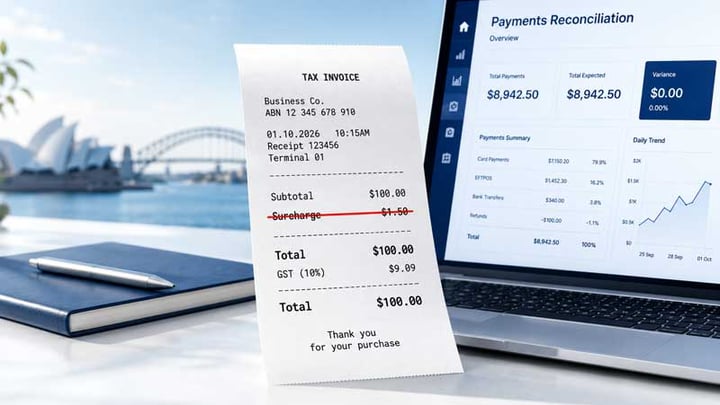
Imagine absorbing the cost of card acceptance on every single transaction, night after night, without ever passing that cost back to the customers who chose to pay by card. That's exactly what happens on 1 October 2026 in Australia. From that day, the Reserve Bank of Australia is abolishing the surcharge on card payments. Consumers currently pay around 1.6 billion Australian dollars a year in such surcharges. That money disappears, and with it an item that until now offset the merchant's card fee.
For you as a finance leader, this is more than a question for the POS. When the surcharge disappears, your business bears the fee in full itself. Payment reconciliation then decides whether you can explain these costs cleanly or whether they end up as an unexplained difference on your balance sheet. This article gives you a simple overview: what changes, why it affects the finance department, and why payment reconciliation now becomes a C-suite issue. You don't need a degree in regulation for this, just half a coffee break.
What Changes on 1 October 2026
Australia is following an international trend. In the EU and the UK, surcharges on common consumer cards have largely been abolished since 2018. So Australia is not the first country to take this step. What's notable, though, is that Australia had until now expressly permitted the surcharge and is now changing direction. Anyone who understands the Australian reform understands where card fees are heading in other markets too.
The Removal of the Surcharge at Its Core
The surcharge is the extra charge a merchant adds to the customer's bill at the till for using a card. From 1 October 2026, this is no longer permitted for the three major four-party schemes.
- Affected are eftpos, Mastercard and Visa.
- The change applies to debit, prepaid and credit cards on these schemes.
- The surcharge may no longer appear as a separate line on the receipt, in the menu or at the online checkout.
At first this sounds like a purely till-side matter. But the real effect only shows up in accounting, and we'll come to that shortly.
Amex, Diners and BNPL: The Exceptions Many Overlook
It pays to look closely here, because not every card product follows the same rule.
- Three-party schemes formally fall outside the change. Companies such as Amex, JCB or UnionPay have, however, voluntarily committed to changing their acceptance rules from the same date. So in practice there is effectively no surcharge on these either, just via a different legal route.
- Diners Club and buy-now-pay-later providers also fall outside the RBA rule directly. Their status has to be treated separately and is not yet conclusively settled.
For you, this means: during the transition period, different rules apply depending on the card product. That's precisely what makes later payment reconciliation more demanding, because some transactions carry a surcharge and others don't.
The Other Half of the Reform: Falling Interchange Caps
The removal of the surcharge is only half the story. In parallel, the RBA is lowering interchange fees. That's the part of the card fee that flows to the card issuer.
- Domestic credit cards: new cap of 0.3 per cent of the transaction value.
- Domestic debit and prepaid cards: new cap of 8 cents or 0.16 per cent of the transaction value.
- Foreign-issued cards: new cap of 1.0 per cent, but only from 1 April 2027.
Card issuers' income falls as a result by an estimated 660 million Australian dollars a year. What matters for you: a lower cap only saves money if your payment processor actually passes it on to you. Whether that happens isn't something you'll see in the legislation. You'll only see it on your statement.
New Transparency Obligations
So that you can check this pass-through at all, the RBA requires more transparency.
- Large payment processors and card schemes must publish their fees.
- Merchants receive standardised information on their statements, planned from April 2027.
- A first public assessment of the pass-through of the lowered interchange is due from 30 January 2027.
That's good news. For the first time you get structured fee data that can be checked. Whether you seize this opportunity depends on how well your payment reconciliation is set up.
Why This Is More than a till Matter
As long as your business surcharged, you passed the card fee on to the customer. The surcharge was a buffer. It neutralised part of the cost before it hit your margin.
This buffer now disappears. The merchant service fee, meaning the payment processor's fee, stays entirely with you. You have two options: you absorb the cost, or you build it into your base prices. Both change your figures, and both have to be represented cleanly in accounting.
This is exactly where a till matter becomes a finance matter. The card fee moves from a passed-on item to a genuine cost item in your profit and loss statement.
What the Removal Means for Payment Reconciliation
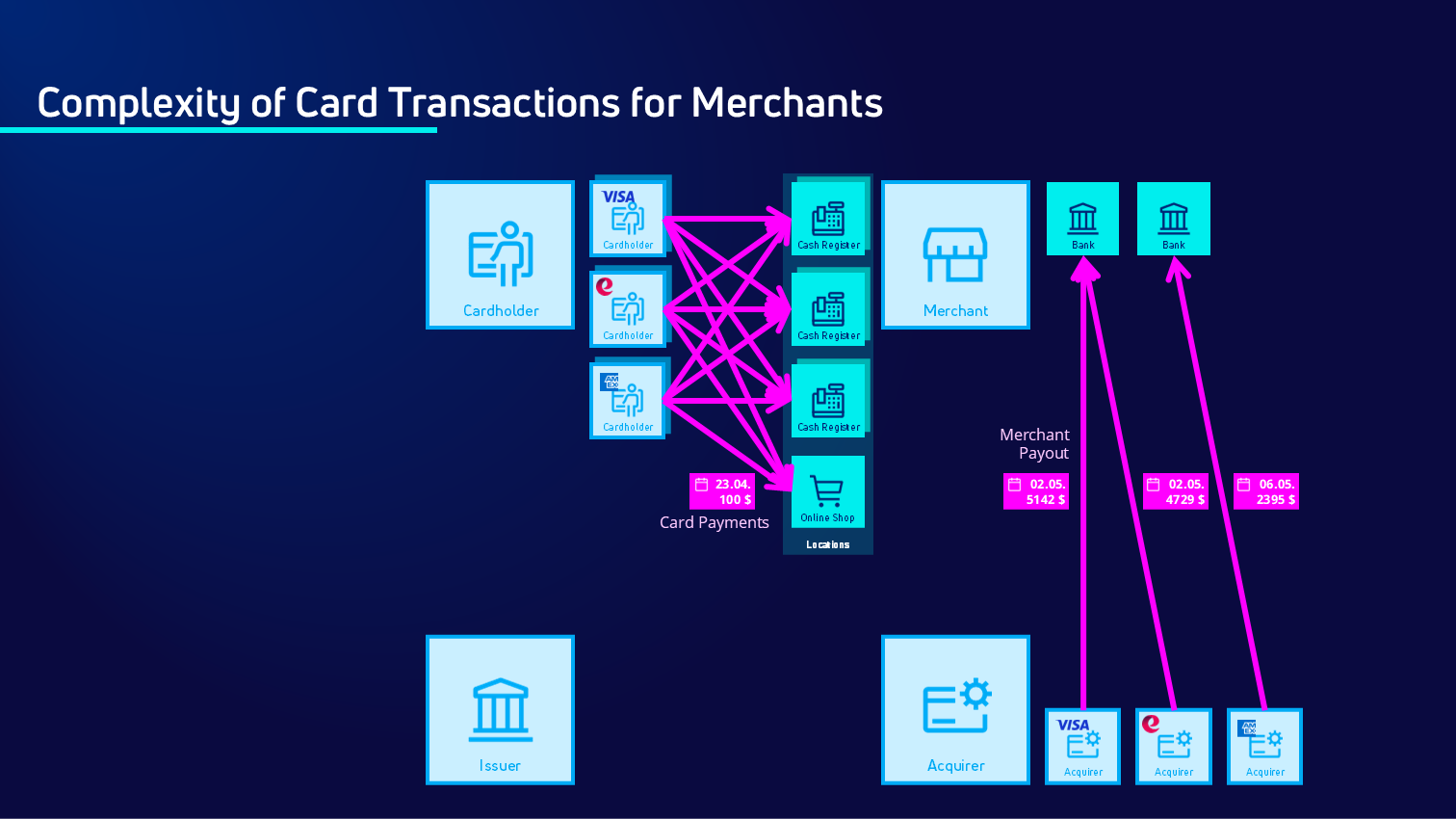
Payment reconciliation compares what was sold at the till with what actually arrives in the account. Sounds simple. In practice there are many stumbling blocks between the two figures, and the reform makes some of them bigger.
The Fee Becomes a Full Cost Item
Payments from payment processors arrive aggregated. Many individual sales become a single bulk transfer from which fees and commissions have already been deducted. These fees are rarely transparently shown for the individual transaction.
As long as the surcharge neutralised these costs, the gap between sale and incoming payment was smaller. Now the full fee is the difference you have to explain. Anyone who can't break this difference down to the transaction eventually just accepts it. That's the beginning of unverifiable figures.
A Simple Worked Example
Take a purchase of 100 Australian dollars. The payment processor keeps its fee, let's say 1.20 dollars, and transfers 98.80 dollars. These figures are illustrative, but the principle is real.
Until now you might have charged the customer 1.20 dollars as a surcharge. The till then showed 101.20 dollars, and the fee was offset. If the surcharge disappears, 100 dollars remain at the till but only 98.80 dollars in the account. The 1.20 dollars difference is now your cost alone.
Multiply that by thousands of transactions a day. A small amount per receipt quickly becomes a significant item. This is exactly the item you have to allocate cleanly in payment reconciliation, otherwise it grows unnoticed into a rolling difference.
The Gap Between till and Account Has to Be Explained
Your open receivables arise from netting sales and settlements. As soon as these two figures don't match cleanly, a difference arises that is hard to explain.
This difference is often carried forward as a balance. Sometimes it's higher, sometimes lower. This is called a rolling difference. With ReconHub customers, such amounts have already reached six-figure magnitudes. If the surcharge disappears and the fee becomes a full cost item, the risk grows that this rolling difference becomes larger and harder to keep track of.
Two Fee Regimes in One Financial Year
The reform doesn't come on a single cut-off date, but in stages.
- On 1 October 2026, the removal of the surcharge and the new domestic interchange caps coincide.
- On 1 April 2027, the caps for foreign cards and the standardised statements are added.
For your accounting, this means: within a single financial year, different fee structures apply one after another. Historical comparisons and trend metrics such as revenue against open items have to take this break into account. Anyone stubbornly comparing prior-year figures draws the wrong conclusions.
Mixed Rules by Card Product
Not all transactions carry the same surcharge during the transition period, since eftpos, Mastercard and Visa are affected immediately, Amex, JCB and UnionPay follow voluntarily, and Diners and BNPL remain unclear. Whether a merchant can actually apply this differentiation, however, depends on their acquirer and terminal. Specifically, whether either (or both) supports surcharging split by card type.
If the till is misconfigured for even a single card product, wrong amounts arise. You won't see these errors at the till. You'll only see them weeks later as an unexplained difference in payment reconciliation.
The Tax Effect
The surcharge was part of the taxable amount. If it disappears or moves into the base price, the tax base per transaction shifts.
If an unexplained difference is later booked as extraordinary income or loss, this has a direct effect on GST. Subsequently recorded sales need their tax share, write-offs reduce it. In a tax audit, you have to explain these adjustments. If the difference can't be explained, neither can the tax correction.
The Hidden Risks for CFO, Controller and Accounting
The reform puts a finger precisely on the wounds many finance departments already know. They just become more visible now.
- Unverifiable balances. Balance sheet figures arise from netting. Without a view of every single transaction, differences are hard to explain, and unexplained figures can't be verified.
- Audit risk. Auditors accept small items as long as they're immaterial. But they can demand an explanation or insist on booking it as extraordinary income or loss. In the worst case you have to write the amount off.
- Surprise write-offs. A large write-off hits your result unprepared. An unexpected gain, in turn, means not all sales were booked correctly. Both lead to uncomfortable questions.
- Higher audit costs. Unexplained differences create additional work for internal and external auditors. Every hour someone spends proving a bank payment costs money.
These risks aren't new. But the removal of the surcharge takes away a buffer that has softened them until now.
Why Payment Reconciliation Now Becomes More Important
Let's sum up why this topic lands on your desk and not just at the till.
First, you'll bear the card fee in full from now on. This makes every unexplained fee difference a genuine margin issue. Second, the reform gives you checkable fee data for the first time. You can verify whether your payment processor really passes on the lowered caps. That's a classic target-versus-actual comparison: expected fee against actually charged fee.
Without clean payment reconciliation, this control stays theoretical. You'd then have the right to lower fees, but no proof of whether they arrive. With clean reconciliation, the right becomes a measurable advantage.
In short: the reform doesn't shift card costs away, it makes them visible. But visible is only useful if you also reconcile the data.
What Finance Leaders Should Do Now
You don't have to wait until the cut-off date. These steps help you be prepared.
- Take stock. Check where you surcharge at all today, in which channels and for which card products.
- Check tills and terminals. Make sure the surcharge is removed everywhere, in the branch, online shop and app at the same time.
- Clarify your pricing strategy. Decide deliberately whether you absorb the fee or price it in, and document the decision.
- Recalibrate your expected values. Adjust the target values of your reconciliation to the new fees and prices.
- Check that the caps are passed on. Use the new transparency data to check whether your payment processor really passes on the lower interchange caps.
- Automate reconciliation. The higher your transaction volume, the less a manual process can carry this added complexity.
How ReconHub Supports You
ReconHub is built for merchants, independent of the payment processor. The solution supports all payment methods and all sales channels. That's exactly what you need when different card products follow different rules during the transition period.
 The core is transparency that wasn't possible before. ReconHub breaks the aggregated payments from your payment processors down to the individual transaction. This makes the fee traceable per transaction, and you can run the target-versus-actual comparison against the new caps. Unexplained differences and rolling balances become visible early, instead of quietly building up.
On top of this come simplified audit processes through automation and digitalisation. When every entry has supporting documentation, your audit risk drops, and the evidence for the auditor is more quickly at hand. The effort the reform creates thus becomes a structured process instead of a never-ending manual task.
Conclusion
The end of the surcharge in Australia is more than a rule change at the till. It takes away a buffer that has offset the card fee until now, and turns it into a full cost item in your profit and loss statement. At the same time, interchange caps are falling and transparency is rising. These three movements together put payment reconciliation at the centre.
For CFOs, controllers and accounting, this means: anyone who bears the fee themselves has to be able to document it. Anyone who wants to use the new caps has to be able to check they're passed on. Both only succeed with clean, automated reconciliation. The good news is that the reform gives you the data for this for the first time. Use it before a quiet difference becomes a big write-off.
Want to know how big your unexplained fee difference really is today? Book a short demo and see how ReconHub makes your card fees visible down to the transaction. Share this article with your finance team if the transition is coming up for you too.
Want to know why petrol stations, EV charging operators, and quick service restaurants are hit hardest? Read on.
Sources
Reserve Bank of Australia: Impact and Implementation, FAQs Removal of Payment Surcharges From 1 October 2026
Australian Banking Association: New Rules for Card Payments