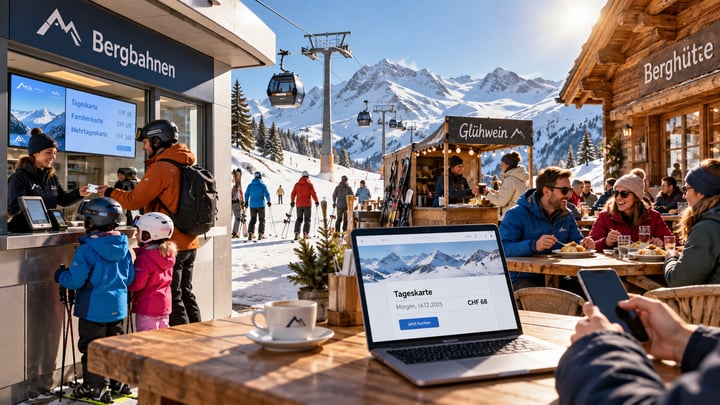
One ski day, four payments. In the morning, a family buys their tickets at the desk. At lunch, there's rösti at the mountain hut. In the afternoon, a guest from abroad pays for a mulled wine at the pop-up stand. In the evening, someone books tomorrow's day pass online.
For the guests, that's a great day. For accounting, this is where the work begins. Payment reconciliation at a mountain railway has to bring together tickets, restaurants, events and shops. On top of that come several POS systems, several payment methods and, in some cases, several currencies. Payment processors transfer the amounts in bundles. What belongs where?
In this article, we show you why mountain railways with their own gastronomy are an especially demanding environment. You'll learn where discrepancies arise and how VAT, foreign currencies and mobile terminals come into play. We also show why reconciliation down to the individual item makes the difference. At the end, you'll find a list of questions you can check in your own operation right away.
A Mountain Railway Is a Small Ecosystem
In 2025, Swiss cable car operators generated revenue of CHF 1.8 billion, CHF 200 million more than the year before. In 2014, revenue was still just under CHF 1.2 billion. The industry is clearly growing.
The composition is interesting. Transport revenue from the winter season still accounts for half of total revenue, and summer for one fifth. Gastronomy and hospitality account for 18 percent, and that figure covers both areas combined. Even so, almost one in every five francs is generated outside ticket sales.
The summer business is also growing mainly thanks to international guests, who increasingly visit the Swiss mountains in summer as well. That adds another factor accounting has to keep an eye on: guests pay with card products from all over the world.
Anyone who runs tickets, restaurants, events and shops deals with many payment sources:
-
Ticket desks at several locations
-
A web shop for day passes and season passes
-
Several restaurants across the ski and hiking area
-
Special events with mobile terminals that move between locations seasonally
-
Payments in foreign currencies
The Payment Mix Changes Faster than Your Budget Cycle
How do your guests pay? The answer keeps changing. The Swiss Payment Monitor1 from the University of St. Gallen and ZHAW illustrates this well. The figures describe the Swiss population as a whole, not mountain railways. But they show how fluid the payment mix is.
In the 1/2026 edition, debit cards led in in-person payments at 27.1 percent, closely followed by cash at 26.5 percent. Just a few months later, the 2/2026 edition paints a different picture. For in-person payments, mobile payment leads by number of transactions for the first time since the survey began, ahead of cash and debit cards. In online retail, mobile payments account for 74.4 percent of transactions. That affects your ticket web shop too.
What does this mean for you? Your payment mix will remain heterogeneous for good. Cash, debit card, credit card, TWINT and other mobile solutions run in parallel. Each payment method has its own fees, its own payout times and its own reports. For accounting, that means more formats, more points in time, more exceptions.
Why Aggregated Payouts Are the Real Problem
The core of the problem is quickly explained. Payment processors transfer aggregated amounts. Fees and commissions are not shown transparently per transaction. On top of that, there are timing differences between the sale at the desk and the credit to your account.
At a mountain railway, this gets worse because of the many points of sale. The valley ticket desk, the mountain lodge, the kiosk and the event stand all sell at the same time. In the end, your bank account often shows a single collective credit that can't be traced back to individual sales without the matching settlement data.
What happens to the difference? In manual reconciliation processes, such differences can be carried forward as open balances over several periods. If their cause stays unexplained, they eventually have to be analyzed, corrected or, depending on the circumstances, written off. The result is a rolling difference that fluctuates over time. The tricky part: nobody can say whether the fluctuation is fine. Maybe it's just the timing shift of settlement. Maybe there's a real problem behind it.
In large companies, such amounts can become substantial. Unexplained differences below the materiality threshold don't necessarily lead to a closing adjustment. Auditors can still ask for evidence or an explanation. For the CFO, this creates an audit risk that is hard to defuse without clean documentation.
A useful metric is the trend of revenue against the open items balance. If the two lines drift apart, it's worth a closer look.
Down to the Item: Reconciliation at Line-Item Level
Classic reconciliation compares sales with payouts at receipt level. That's a good start. For a mountain railway with many different services, though, it often isn't enough.
A receipt typically contains several line items, depending on where payment is made. Three examples:
- At the ticket desk: two adult day passes, one child day pass and one booked activity
- In the mountain lodge: two menus eaten on site, one beer, one mineral water and one takeaway coffee
- In the shop: one hat and one water bottle as merchandise items
At receipt level, you only see the total amount. At line-item level, you see each item individually. This is exactly where ReconHub's Order Management comes in. If your POS can report the items, ReconHub doesn't just reconcile the receipt amount, but goes down to the individual booked activity or the merchandise item sold.
That gives you three advantages:
- Clearer allocation: You see how much each area contributes to revenue.
- Simpler VAT calculation: Every line item has its own tax rate. That makes the calculation easier when rates differ.
- Better inventory data: Line-item data helps you check sales movements against inventory data and investigate differences more precisely.
One Receipt, Several VAT Rates
VAT1 is the area where line-item data makes the biggest difference. In Switzerland, the standard rate is currently 8.1 percent, the reduced rate is 2.6 percent, and there is a special rate of 3.8 percent for certain accommodation services.
For a mountain lodge with a restaurant, this means the rate depends on what you sell and how. What's consumed on site counts as a restaurant service at 8.1 percent. What's taken away counts as a food sale at 2.6 percent for food. According to GastroSuisse1, the reduced rate applies to food and non-alcoholic beverages sold over the counter or delivered to the home, provided no preparation or serving services are provided on site. According to a trade article, alcoholic beverages always stay at the standard rate, regardless of whether they're drunk on site or taken away.
A coffee on the terrace and a takeaway coffee can be subject to different rates. A mulled wine with alcohol, on the other hand, generally remains subject to the standard rate even when sold at a stand. Merchandise items and activities have their own tax treatment. Transport has its own treatment as well. Which rules apply to your railway is something to clarify with your tax advisor.
In practice, every line item on the receipt must be clearly assigned to a tax rate. For combined offers such as ticket plus meal, another rule comes in. Different VAT rates can be relevant. Depending on the composition, the services have to be treated separately. Under certain conditions, however, VAT practice allows a simplified treatment of service bundles. The specific tax classification according to the Federal Tax Administration (FTA1) should be reviewed with a tax advisor.
What happens without line-item data? If an unexplained difference is booked as income or loss, it has VAT consequences. Sales recorded after the fact require VAT, write-offs reduce it. Without knowing the underlying items, even the correct tax treatment of a difference can be difficult. In a tax audit, you have to explain these adjustments. If the difference can't be explained, neither can the VAT difference.
From Receipt to Inventory
The line-item level helps with inventory too. In the restaurant, that means goods from the kitchen and bar. In the shop, it means the merchandise items.
Consider two typical cases. In the first, there's a sale without a payout. The product has left the building, inventory has dropped, but the payment is missing. In the second, there's a payout without a POS record. The product is gone, the sale wasn't registered, and inventory most likely wasn't adjusted.
Without line-item data, it's hard to determine which products are affected. The result is inventory inconsistencies that show up later, at stocktaking, as larger corrections. With line-item data, you can assign the difference to the item before it becomes a problem.
Seasonal Events and Mobile Terminals
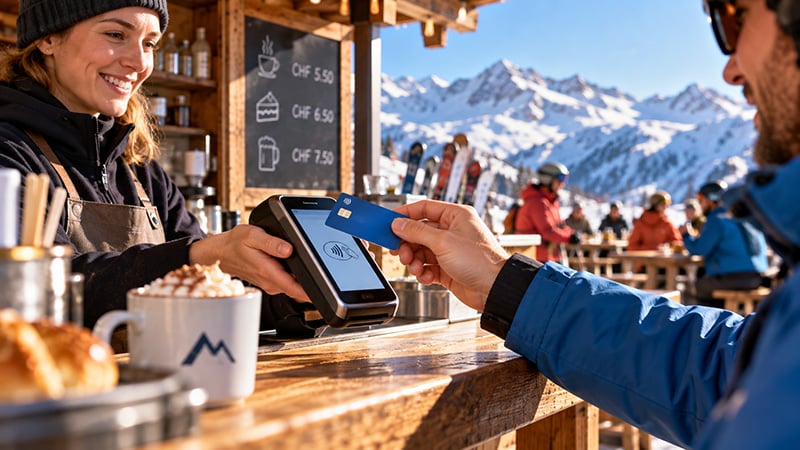
The mulled wine at the event stand is a good example of another challenge. Special events often use mobile terminals that are deployed at different locations each season. This year the terminal is in the parking lot, next year at the mid-station.
For reconciliation, that's demanding. Payments have to be assigned to the right location, otherwise the income statement is off. Events bring further typical problems:
-
Many identical amounts. A mulled wine always costs the same. If you reconcile manually, it's almost impossible to tell individual payments apart.
-
Late end of day. Events often run past midnight. This shifts the trading day against the calendar day.
-
Changing locations. The terminal moves, so the assignment has to move with it.
The more of these cases come together, the less viable a manual solution becomes. It's error-prone, time-consuming and hard to transfer to new locations.
Foreign Currencies in Summer and Winter
Guests from abroad pay with cards from all over the world. For you as an operator, this means that international cards bring foreign currency effects and, where applicable, DCC transactions into play. This is true even though the merchant still receives its settlement in Swiss francs.
With DCC, the guest is offered the option at the terminal to pay in their card currency instead of Swiss francs. The conversion is done by the DCC provider or payment processor, and not later by the card-issuing bank. Nexi Switzerland names tourism, hospitality and retail as industries where DCC revenue adds up quickly with a high frequency of international guests. According to the trade press, merchants often receive a commission when guests accept conversion into their home currency. With some providers, this credit arrives at the end of each month as a separate credit from the acquirer.
Not every mountain railway uses DCC. If you do, it has consequences for reconciliation. The sales amount at the terminal, the payout amount and the DCC credit diverge. They arrive at different times and in different forms. A reconciliation that only looks at the total amount can't explain these effects cleanly.
A practical tip: ask your payment processor how DCC payments and credits appear in its reports. Then you'll know what information you need for reconciliation.
Online Tickets and Dynamic Pricing: One More Channel
For many mountain railways, the web shop has long been a main channel. Dynamic pricing has reinforced this. From 2017, the first large Swiss ski areas introduced dynamic prices for day passes. Today, ski day passes in many areas can be booked online under a dynamic pricing model.
From the operator's perspective, the shift online has a clear advantage. It relieves the desk infrastructure and shortens queues on busy days. For accounting, it adds yet another channel. Online payments have their own payouts, their own timing and often different payment methods than the on-site desk.
Dynamic pricing adds something else: a fixed reference price isn't suitable as an additional matching criterion. The actually booked amount and unique transaction or order data become all the more important. Line-item data helps here too, because it shows what was actually sold.
Railway or Gastronomy: Who Really Makes the Money?
Now to the question behind it all. On what data do you decide which area is profitable?
If you only see payouts in aggregate, the answer often remains an estimate. Payment processor costs are spread across all points of sale. Revenue from tickets, restaurants and the shop runs through the same accounts. Without a clean allocation of payments and payment costs to location and area, the profitability calculation lacks an important part of its data foundation.
With a reconciliation that covers all payment methods and sales channels, this changes. ReconHub is built for merchants and works independently of payment processors. That gives you transparency that wasn't possible before, and new control over your payment flows. It helps you make decisions, for example on whether an additional event location is worth it.
It's a win for audits too. Evidence for open items is easier to provide when every payment is traceably assigned. That saves time for auditors and accounting. It also lowers the risk that unexplained differences end up having to be booked as a loss.
What You Can Check in Your Operation Now
These questions help you assess where you stand:
- Channels: Which points of sale and payment paths do you have? Are all of them covered in your reconciliation?
- POS data: Can your POS systems report individual items, for ticketing, restaurants and events?
- Rolling difference: How high is the carried-forward balance? How does it develop compared with revenue?
- VAT: Is every line item assigned to a tax rate, including combined offers?
- Events: Can you reliably assign payments from mobile terminals to the right location?
- Foreign currencies: Do you know how DCC payments and credits appear in your accounts?
- Profitability: Can you show how much each area contributes to the result?
If you hesitate on several questions, a closer look is worthwhile.
Conclusion
A mountain railway with its own gastronomy is a small ecosystem of POS systems, web shop, restaurants and events. Each channel brings its own payment paths. Payment processors transfer in bundles, and time differences, foreign currencies and changing locations make assignment harder.
Aggregated amounts aren't enough for this. At receipt level, much remains assumption. At line-item level, it becomes traceable, for VAT, for inventory and in the audit. This requires your POS to report the items. If it does, ReconHub's Order Management can carry the reconciliation down to the individual activity or merchandise item.
Our advice: start with the seven questions above. They quickly show you where you stand. After that, you'll know where automation pays off most.
Want to know what reconciliation down to the individual item could look like at your railway? Get in touch for a no-obligation conversation.
1Sources
IT Magazine: Mobiles Bezahlen stagniert in der Schweiz, Gastroinsider.de: Mehrwertsteuer Gastronomie 2026: DACH-Übersicht, Swiss Payment Monitor: Aktuelle Ergebnisse Swiss Payment Monitor, GastroInsider: Mehrwertsteuer Gastronomie 2026 DACH-Übersicht, Jamatsu: MWST im Restaurant - Was Gastronomen wissen müssen, ESTV: MWST-Branchen-Info 09