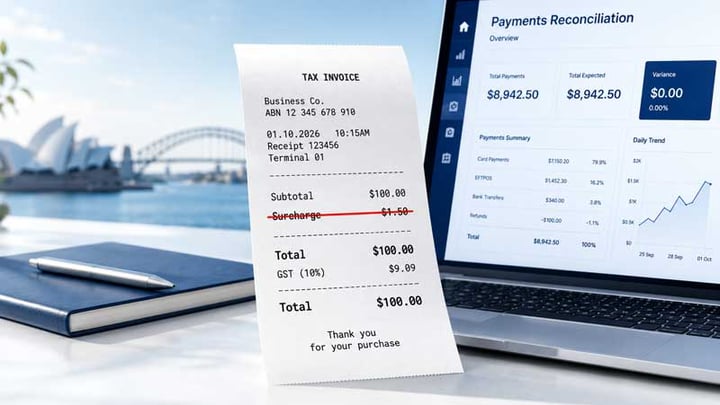
Payment cards such as credit and debit cards have become indispensable in digital payment transactions. They offer customers convenient payment options and enable companies to realize sales quickly. But behind the seemingly smooth process lies an underestimated risk: the reconciliation of payment card payments within the order-to-cash (O2C) process. It is worth taking a closer look, especially for financial managers such as controllers and CFOs - because if you don't look here, you run the risk of losing transparency and efficiency in the financial area.
The O2C Process: From Order to Payment - But Not Always Synchronized
The classic order-to-cash process covers all steps from order entry, delivery and invoicing to payment and posting. While many companies focus on order entry and invoicing, payment processing - especially for card payments - is often seen as a purely technical step. Yet it is precisely this part that is critical for the accuracy of accounting and receivables management.
The Reality with Payment Cards: No One-to-One Relationship Between Sale and Receipt of Money
Card payments are usually collected by so-called payment processors and transferred in bundles. In addition, there are fee deductions, payment delays and sometimes incorrect or incomplete intended uses. As a result, the transfer from a payment processor does not exactly cover the individual transactions as they were recorded in the system. This leads to differences, open items and manual reconciliation work.
Lack of Transparency and Incorrect Assumptions in Controlling
Many controlling departments rely on the basic assumption that a successful card payment automatically results in a correct incoming payment. In reality, however, sales and cash receipt data often do not match - sometimes delayed by days, sometimes reduced by amounts. Without detailed reconciliation, the reporting can deliver incorrect cash flow data or show an excessively high DSO.
Relevance for CFOs: Risks for Financial Statements, Audit and Management
CFOs are responsible for valid figures in the financial statements. Unclear or incorrectly allocated card payments jeopardize this validity. Traceability also becomes complex for external auditors if there is no systematic reconciliation. In management, this can lead to incorrect decisions - for example when assessing payment practices or planning liquidity requirements.
Why the Problem Is Often Overlooked
One reason lies in process responsibility: the technical processing of payments is often the responsibility of the IT or operations team, while finance only sees the results. The lack of an interface means that the actual problem of allocation remains invisible from the finance department's perspective. ERP systems do not always offer a suitable solution either, as many are designed for classic invoice-to-payment logic - but not for payment bundles with fee deductions.
Conclusion
Reconciling payment card payments is a critical but often neglected part of the O2C process. Those who fail to recognize and address the specifics of this payment method risk manual effort, incorrect reports and potential reputational damage in the audit. Finance departments should be aware that this is not an automated self-runner - but an area that requires active management and clear responsibilities.
Check your internal reconciliation processes for card payments:
- Is there complete transparency around payment flows from payment processors?
- Are fees and batch bookings systematically broken down?
- Is there a clean interface between IT, Operations and Finance?
If not, it's time to tackle the issue head-on - before it becomes apparent in the annual financial statements. Specialized payment reconciliation solutions such as ReconHub can help to bring transparency and automation to this often overlooked process.